Transit Stops
Purpose 
A safe, ADA compliant, accessible, easily identifiable, and comfortable area for waiting, boarding, and alighting of bus passengers.
Description
A bus stop is an area used for the waiting, boarding, and alighting of bus passengers and includes associated amenities for bus passengers. A bus stop zone is the clear curb and roadway area needed for the bus to safely service the stop.
The bus stop is the first point of contact between the passenger and the bus service. The spacing, location, design, and operation of bus stops significantly influence transit system performance and customer satisfaction. The minimum County standard for bus loading areas includes:
- ADA compliant passenger loading pad at all bus stops in Arlington that shall comply with the federal “Americans with Disabilities Act” (ADA), and a bus stop sign designating what transit services provide service to the bus stop, and
- No parking within the bus stop zone.
The requirements for the loading pad are based on ADA and guidance from the U.S. Access Board, Accessibility Standards:
- A firm, stable surface for the passenger loading pad,
- A minimum clear/unobstructed bus stop passenger loading pad of 5 feet parallel to the road/curb by 8 feet perpendicular to the curb (the existing width of a sidewalk may be counted towards the 8 feet wide perpendicular to the curb area),
- A maximum cross slope of 1:50 (2%) for the passenger loading pad, and
- Connection to/from the passenger loading pad, curb, and sidewalk or pedestrian path by an accessible route.
Bus Bulbs: Another option at a bus stop is the use of a bus bulb. A bus bulb is a curb extension with a bus stop. Instead of the bus pulling out of traffic to allow passengers to board and alight, bus bulbs allow buses to stop in the travel lane. This reduces conflicts with other vehicles by eliminating the need for buses to merge in and out of traffic at the stop.
Safety Benefits
- Improves access, safety, convenience, and comfort and may encourage the use of transit.
- Accommodates transit users of all abilities and ensures ADA compliance and accessibility, improving independent mobility by providing options other than the reliance on more costly paratransit service.
Street Types and Context
Applicable Street Types
All except Controlled Access Highways.
Other Location Guidance
There are three general placement classifications of bus stops:
- Far-side bus stops are positioned adjacent and past the intersection. Far-side stops are generally preferred by designers. They allow pedestrians to cross behind the bus, which is safer than crossing in front of the bus. On multi-lane roadways, they also increase the visibility of crossing pedestrians for drivers waiting at the signal.
- Near-side stops are positioned adjacent to the intersection as the bus approaches the intersection. Near-side stops should be used when far-side stops are not feasible to install or if the trip generator is near-side (hospital, senior center, etc.).
- Mid-Block stops are used away from intersections typically along blocks where there is a major destination or trip generator mid-block. More curb space is typically required to implement a mid-block stop.
Primary User Groups

Key Implementation Considerations
- Comprehensively evaluate potential safety concerns, including personal safety, when designing waiting, boarding, and alighting areas.
- Access to street crossings must be provided, including crosswalks and curb ramps.
- Provide adequate sight distance, e.g., provide visibility between bus operator and waiting riders.
- Consider impacts on other traffic such as vehicles, pedestrians, bicycles.
- Bus operational movements must be accounted for in roadway design.
- PROWAG and ADA compliant and accessible pathways that connect the bus stop to destinations (trip generators).
- Based on ridership and other criteria, bus stops can include a variety of other passenger amenities including static and real-time bus information, lighting, benches, shelters, trash receptacles, and bike/micromobility parking
- The County is currently in the process of reviewing the compliance of existing bus stops. Bus stops that do not meet the minimum standards are added to the queue for upgrade to ensure the proper loading space.
- Bus stops are prioritized through the review of ridership and other criteria. Additional amenities are considered along with the requirement for compliance with the minimum standard.
Expected Crash Reduction
The expected crash reduction for this treatment varies with the type of transit stop and its design. A 1% reduction in pedestrian crashes is expected with the installation of farside bus stops (ITE, 2004).
Cost

Right-of-way (ROW) acquisition, utility relocations, the proposed site (needing grading, drainage, retaining walls, etc.), and design are the most variable expenditure for bus stops and can be extremely costly. Additional amenities such as benches, bus shelters, and real-time information can be high cost, however, these costs are identifiable and less variable.
Timeline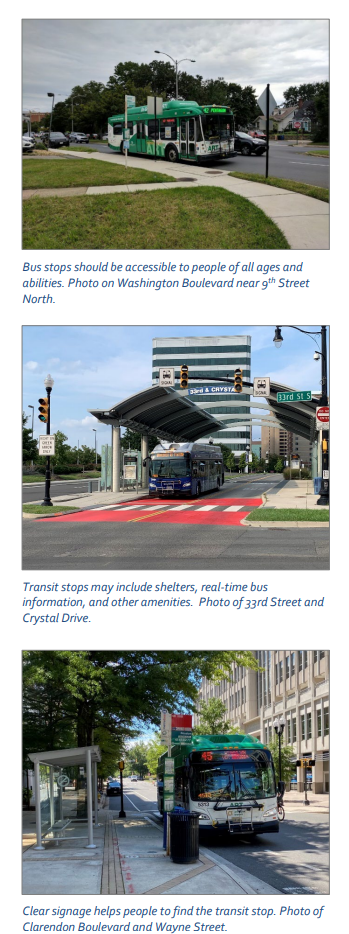

Less than one to three or more years, depending on complexity.
References