EHO Trial and Appeal Information

On September 5, 2025, the Virginia Court of Appeals again reversed the Circuit Court’s judgment in the EHO trial and sent the case back to the Circuit Court. As of October 1, the EHO Permit type in Permit Arlington is available for new applications. Property owners with approved EHO permits or permits that were under review at the time of Circuit Court ruling should email contactzoning@arlingtonva.us.

The Arlington County Board voted on Tues., Nov. 19, 2024, to appeal the decision in the case of Nordgren v. Arlington County Board ("EHO trial") — view the statement from the County Board.

Throughout the Missing Middle Housing StudyEHO process, and recent trial, the County regularly provided additional information and numerous documents online. In the interest of continued transparency, Arlington County is sharing transcripts from the trial and key arguments presented:

Evidence Presented at Trial

The County’s interdepartmental team had robust discussions and analysis on how EHO would impact County systems. Below is a high-level summary of the analysis that was performed.

School Enrollment

The County consulted with Arlington Public Schools and its demographer to project the rate of increased student enrollment due to the EHO Amendment. APS’ analysis projected an additional 9-13 students annually resulting from the EHO Amendment.

For additional information, please consult the transcripts from Trial Day 4(PDF, 538KB) and the Deposition of Robert Ruiz from Arlington Public Schools(PDF, 328KB).

aps demographics.jpg

Stormwater

After robust discussion and debate between the members of the interdepartmental team, the County amended its initial recommendation to reflect a more conservative approach for EHO Development in which the building envelope of EHO development is equivalent to that of single-family development. As a result, EHO Development will not cause impacts more severe than the status quo of single-family development.

Furthermore, the County’s data show that single-family development accounts for an increase of only 0.06% of overall County impervious surface per year, and EHO development would account for only a fraction of that small percentage. Based on those figures, the County’s expert testified that EHO would have a de minimis effect on stormwater relative to the status quo.
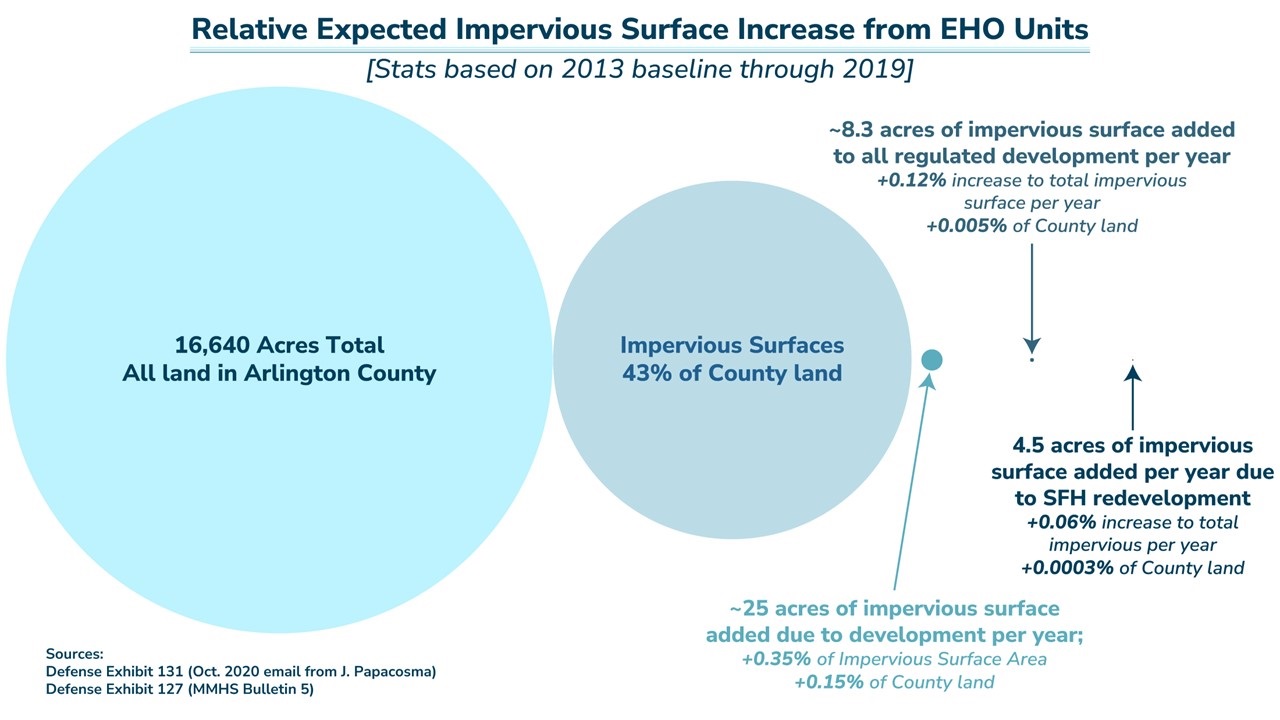
impervious surface increase from EHO units.jpg

The County is further pursuing initiatives to find ways to improve stormwater system resiliency.

For additional information, please consult the trial transcripts from Day 5(PDF, 2MB).

 Sanitary Sewer

In 2020, the County hired a consultant to study its sanitary sewer system and develop a dynamic hydraulic model which allows the County to study the capacity of every sanitary sewer pipe in its system.

historic flows at WPCP.jpg

The data shows that while the population has increased, water usage has decreased. This is due in part to more efficient modern appliances and infrastructure as redevelopment occurs. The County’s system currently has so much excess capacity that EHO development would have a marginal impact on the capacity of the system.

water consumption.jpg

On a granular level, the County identified only four areas where pipe capacity needed attention. Those areas are currently identified for improvement in the County’s CIP or already under construction. Furthermore, EHO development has the potential to increase efficiencies as old private sewer laterals and other infrastructure is replaced with newer, more efficient infrastructure in the redevelopment process.

For additional information, please consult the trial transcripts from Day 5(PDF, 2MB).

 Transportation

Using data from previous neighborhood parking capacity survey, the County was able to conclude that EHO development would have a marginal effect on parking capacity in the low residential districts, where parking averages at 26% capacity.

Using traffic data collected from the Washington Council of Governments, the County was able to conclude that EHO development would have a marginal effect on traffic.

For additional information, please consult the trial transcripts from Day 4(PDF, 538KB) .

Background

In March 2023, the Arlington County Board voted to expand housing options (i.e. Expanded Housing Option (EHO) Development) in portions of the County that currently only allow single-detached homes, concluding a multiyear process. The Board actions came after nearly 250 community members and organizations spoke in two days of public hearings, in addition to the thousands of people who engaged with the County throughout the study, which began in 2019. Many details in the final Board action reflect input received from the Arlington community. 

Expanded Housing Option (EHO) Development offers an alternative on single-family residential lots that allows for the construction of duplexes, townhouses, and multifamily buildings that meet the design standards in Arlington County Zoning Ordinance (ACZO) §10.4 Expanded Housing Option Development.   

Some homeowners in Arlington filed a lawsuit in Circuit Court (Nordgren v. Arlington County Board), alleging the County Board "was not forthright with County residents in explaining the purpose of the Missing Middle Housing proposal, the scope of the changes it contemplated, and the studies and analysis it claimed would be done before the proposal was advertised and submitted to a vote."

On Sept. 27, 2024, the judge in the case ruled against the County on four counts, namely that the County's use of an RTA as an initiating resolution was invalid, the County did not adequately consider the localized impacts of EHOs on privately owned sewer laterals, the County could not have EHO be a by-right use, and the County did not have authority to impose a shade tree provision. 

The County Board voted to appeal this ruling on Nov. 19, 2024.

Frequently Asked Questions About the EHO Ruling and Process

What did the judge rule? Why did the judge rule against the County?

The judge ruled against the County on four counts, namely that the County’s use of an RTA as an initiating resolution was invalid, the County did not adequately consider the localized impacts of EHOs on privately owned sewer laterals (the portion of a plumbing system that connects pipes on private property to the public County-owned pipes), the County could not have EHO be a by-right use, and the County did not have authority to impose a shade tree provision.

In his ruling that overturned the EHO (Expanded Housing Options) Zoning Amendments, the judge ruled that the EHO amendments passed by the County Board were void ab initio (as if they had never existed) and enjoined the County from issuing further permits or continuing to approve EHOs.
As a result, the County voided all EHO permits and halted all review processes related to EHO development. During an Oct. 25 hearing, the judge issued a partial stay of the judgment for the 45 approved EHO permits if property owners meet certain conditions.

Why did the County choose to appeal the ruling?

Statement from the Arlington County Board: 

Since late September, the Board has deliberated on the ruling in the Expanded Housing Option Development trial (Nordgren v. Arlington County Board). We have heard from residents, reviewed the final order, and consulted with both the County Attorney and outside legal counsel.

The Board has directed the County Attorney to appeal the ruling. The Board considered adopting a revised ordinance but determined that it is not feasible to do so based on the legal construction and substance of the judge’s ruling. We, and many jurisdictions across Virginia, are concerned that this ruling will have impacts that extend well beyond our EHO policy, impacting our current, decades-long understanding of how land use decisions are made and implemented under local jurisdiction. These concerns must be addressed and clarified by a higher court.

We believe that the County has fully complied with Virginia law and has good grounds for appeal. While we await the appeal, staff will adhere to the ruling as it stands. The County will also continue its work to address housing needs across our community.

What does the partial stay mean for approved EHO permits?

The partial conditional stay for the 45 EHO permits approved before the initial Sep. 27 ruling allows property owners to proceed with their EHO development only if they add a notice to their property land records.

Per the judge’s order, the notice on land records must read: "To potential purchasers, please be advised that a lawsuit is on appeal to the Court of Appeals of Virginia and then perhaps to the Supreme Court of Virginia that may void your zoning rights to this property and may result in your right to live in this property being eliminated."

The property owner must provide proof that the notice has been added and the County must verify it has been added before any additional permits related to an EHO project could be issued.

If the property owner does not want to proceed with EHO development, they could shift to a single-detached home, which may involve submitting new plans and/or permits and additional fees. Alternatively, they could pause all development on their property and maintain it in its current state in compliance with all state and local property maintenance requirements.

County staff is in the process of meeting with EHO permit holders to discuss next steps.

What does this mean for EHO?

As result of the judge’s rulings, only those EHO permit holders who add notice on their land records will be able to continue with their EHO project. However, it is important to note, each EHO project must go through the full permit review process and being able to continue through the process does not guarantee that all required permits will be approved. In adherence with the judge’s ruling, no new applications for EHOs can be submitted and the County is also prohibited from issuing any EHO permits that were in process at the time of the Sept. 27 ruling.

What happens now to the EHO process?

Besides those EHO projects where a notice is added to the land records, there is no active EHO process. No new applications for EHOs can be submitted and the County is prohibited from issuing any EHO permits that were in process at the time of the Sept. 27 ruling.

The Permit Arlington team has removed the EHO permit option from the system.

How many EHO permits were already approved?

As of Friday, Sept. 27, 2024, the County had approved 45 EHO permits. Among these projects, 12 demo permits and 7 building permits have been issued. Two projects are under construction, and one certificate of occupancy for an internal conversion has been issued. The overall total of approved EHO units is 186.


How many multi-unit homes have been constructed under EHO?

As of Sept. 27, 2024, two EHO projects were under construction, and one certificate of occupancy for an internal conversion has been issued.