Rosslyn Sanitary Sewer Relining
Construction
Location
1011 Arlington Blvd., Arlington, VA View Map
38.89537007789459, -77.06923416916733
1011 Arlington Blvd. ,
Arlington, VA
1011 Arlington Blvd. ,
Arlington, VA
Rosslyn Sanitary Sewer Relining
StatusConstruction
This project is scheduled to start in early April 2026 and is anticipated to be completed by September 2026. See the "Project Timeline" section for additional information.
Location
The project limits are from the intersection of 19th St. N. & N. Lynn St., down N. Lynn St. and under buildings toward N. Kent St., and down Wilson Blvd. to 1011 Arlington Blvd. (River Place Condominiums) View map
About the Project
Sanitary Sewer
Arlington's sanitary sewersystem is a key piece of infrastructure consisting of approximately 465 miles of sewer pipes and 13 lift stations. This intricate network exists to make sure that the wastewater that gets flushed every day from homes and businesses makes its way to the Water Pollution Control Plant (WPCP) where it’s properly cleaned and treated before being recycled back into the environment. Learn more about our sanitary sewer system.
The project will rehabilitate approximately 2,300 linear feet of the Rosslyn large diameter interceptor, with sewer lines ranging in size from 33 inches to 36 inches in diameter, via trenchless relining. The subject large diameter wastewater sewer serves the entire Rosslyn neighborhood, a heavily urbanized, high density area home to approximately 13,000 residents, 25,000 working professionals, 1,000 businesses, and 2,200 hotel rooms. The project section of interceptor sewer was originally constructed as the Potomac Interceptor in the 1930s. The interceptor sewer was inspected in 2016, and many sections were deemed to require immediate rehabilitation due to structural deficiencies which allow for significant infiltration and inflow and could lead to structural failure.
Inspection
A CCTV inspection conducted in the spring of 2016 revealed that the sanitary sewer pipe had moderate-to-severe deterioration, including:
- Corrosion of concrete pipe
- Exposed aggregate
- Reinforcing steel exposed
- Pipe joint separation
- Infiltration at the joints
- Small cracks
CCTV shows severely exposed aggregate
CCTV shows pipe joint separation
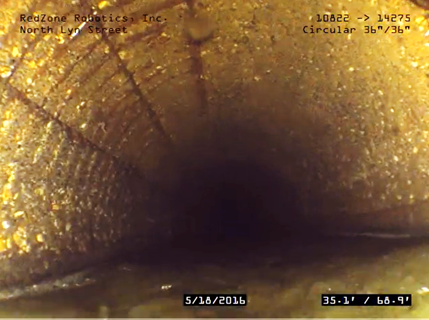
CCTV shows exposed reinforcing steel in pipe
Project Process
Temporary Bypass
A temporary bypass will be installed in order to allow the pipe liner to push through the existing pipe without disruption from existing flow, and in order to allow the pipe liner to correctly adhere to the existing pipe walls and cure (harden) properly.
Due to the length of the project (approximately 2,800 linear feet total), there will be some sections where the bypass is above ground (along 19th St. N., N. Kent St., N. Arlington Ridge Rd., and the River Place Condominiums parking lot) and some sections where bypass will run underground (buried under street crossings – such as at N. Lynn St. and Wilson Boulevard) to avoid significant traffic disruptions once the relining process begins.
Cured-In-Place Pipe Process
Cured-in-place pipe (CIPP) is a trenchless rehabilitation process used to repair existing pipelines using a resin (styrene) saturated felt tube.
CIPP lining involves cleaning the interceptor sewer followed by installation of a resin-impregnated liner to provide structural integrity and reduce groundwater infiltrating into the sanitary sewer. The end result is that the liner functions as a structurally and hydraulically new pipe within the old sewer and there is very minimal open-cut excavation and disruption.

Crews place a flexible liner into the existing sewer. Heated water is forced into the liner, pushing the liner tightly against the existing sewer walls. The heat causes the liner material to “cure” (harden), creating a new pipe within the existing sewer that is free of cracks and holes. The renewed pipe longevity is projected to last 50-70 years.

Example of CIPP using hot water. A boiler truck uses water to cure the liner with a circulation pump.
Project Timeline
Work is scheduled to start in early April 2026 and anticipated to be completed by late September 2026. The project will have four phases; inclement weather and other potential delays could impact work timelines:
- Phase 1 – Bypass Setup (starting at 19th Street North and North Lynn Street, down 19th Street North to North Arlington Ridge Road and then Wilson Boulevard): April-May
- Phase 2 – CIPP Lining: May-July
- Phase 3 – Bypass Teardown (starting at 19th Street North and North Lynn Street, down 19th Street North to North Arlington Ridge Road and then Wilson Boulevard): August
- Phase 4 – Site Restoration: September
Most of the work will take place between 9 a.m-4 p.m. Monday-Friday; however, there will be some overnight and weekend work since the pipe curing process requires crews to work around the clock and allow 24-36 hours for a pipe segment to cure. Overnight work hours will be from 9 p.m.-7 a.m. Monday-Friday, and weekend hours will be from 9 p.m.-10 a.m. Saturday-Sunday.
Project Impacts
Temporary lane closures will be implemented to install the bypass piping, with at least one lane remaining open to traffic at all times. Temporary sidewalk and bicycle lane closures may also be implemented; detours will be provided for any closures. In addition, street parking along N. Lynn St., 19th St. N., and N. Arlington Ridge Rd. will be temporarily restricted. The bypass piping will stay in place until the relining work is completed.
The resin used in the CIPP process contains Styrene, a chemical with an unpleasant odor similar to strong spray adhesives. Pouring water into basement floor drains and those used for air conditioner condensation can sufficiently reduce the possibility of Styrene odor from entering your home. If the Styrene odor is still present, it could indicate a plumbing issue such as a broken or clogged pipe.
During the pipe curing phase, pumps and boilers will run constantly, which will cause noise in and around the work area.
Photo Gallery
view as pdf