To Cut or Not to Cut: Alternative Management Tools for Invasive Plants
Published on June 24, 2015
What is the best way to manage invasive plants? There are many factors to consider before deciding on a particular management strategy. For instance, you wouldn’t treat a dense infestation of kudzu the same as a few plants of garlic mustard. Beyond the species and infestation level, other factors include site location and accessibility, season, and financial or labor resources available. Arlington’s Invasive Plant Program started as a mostly volunteer-driven effort. As the program has grown, we have started incorporating both mechanical and chemical methods for managing invasive plants, but are there others ways? The 2010 version of A Management Guide for Invasive Plants of Southern Forests outlines the four types of management available for invasive plants.
Cultural Methods
Cultural Methods for managing invasive plants include any activities (besides cutting, pulling, or spraying) done by humans to manage invasive plants. One of the most important ways to stop the spread of invasive plants is education. Stopping the spread of invasive plants can be as easy as not planting it in the home landscape. Another example of cultural control is the use of fire to manage certain invasive species in a prescribed burn. Also, at certain sites, managers can utilize Water-Level Manipulation, both reducing and increasing water-levels can reduce invasive plants at a particular site, depending on the species. Mulching and Solarization are other tools for managing invasives by manipulating the plants access to the sun, either by blocking it out or using it to make an environment that is too hot for plants to survive. Finally, managers can replant areas with native plants to compete with or shade out certain invasive plant species.
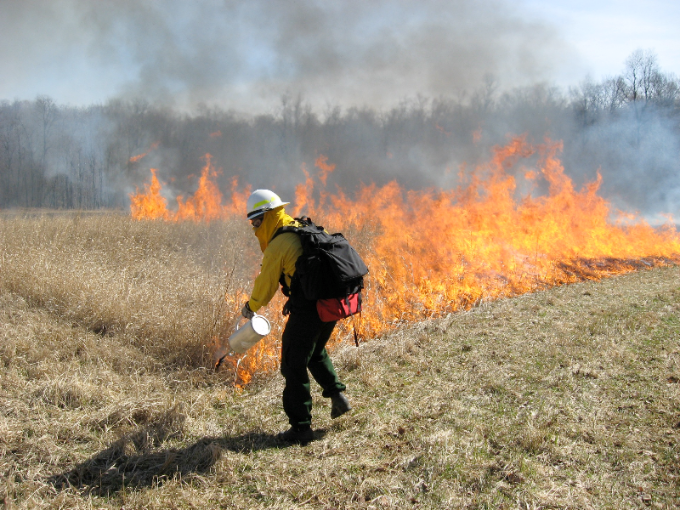
www.hayspost.com
Biological Methods
Traditional Biological Control Methods include the use of any biological organism such as insects or diseases to limit the impacts of invasive plants. One example is the Mile-a-Minute Weevil. Another example that has been in the news lately is the use of cattle, goats or sheep in Prescribed Grazing.

somdnews.com
Mechanical Methods
Mechanical methods include both Manual Methods, either hand-cutting or pulling plants as well as Mechanical Methods with heavy equipment. Volunteers can help a lot with manual methods for removal, but in most cases this leaves the roots of the plants intact and requires additional follow up. Mechanical methods can be effective but may also cause a lot of disturbance to the surrounding habitat.

www.earthsangha.org
Chemical Methods
Finally, chemical tools can also be used to manage invasive plants. In some situations the use of herbicides can be the quickest and most cost-effective way to manage invasive plants. However there may be impacts to the surrounding habitats. There are Selective Herbicide Applications, which can minimize damage to desirable plants. For more infested areas, Broadcast Herbicide

Photo by Steve Manning, Bugwood.org
Management Options for Arlington County
A 2014 Virginia Tech Masters of Natural Resources Capstone Project, called Invasive Plant Management Strategies in Northern Virginia, gave a comparative analysis of invasive plant management practices in the northern Virginia area, including the City of Alexandria, the City of Fairfax, the City of Falls Church, Arlington County, Fairfax County, Loudoun County, and Prince William County, as well as federal, state, and regional properties. The author, Joan Martinez Allen, interviewed natural resource managers and made observations and recommendations for the region.
She concluded that Arlington County has what she considers an established invasive plant management programs because we have Natural Resource staff, management plans, prioritization strategies, data collection, plant inventories, and volunteer programs. One recommendation Allen gives, is that Arlington should employ a full use of management tools. Although in the past we have experimented with several cultural methods, we could explore more opportunities to pilot new management programs. Allen suggests prescribed burning, the use of biocontrols, and (because of their selective browsing on native plant species) deer culling to help manage invasive plant species in Arlington.
If you would like more information about Joan Martinez Allen’s report, or to participate in invasive plant removal project planning discussions, please contact the Invasive Plant Program at (703) 228-1862.